In 2005 LONMARK International Magazine went Digital
Current website: https://www.lonmark.org/
In 2005 LONMARK International Magazine went digital and green, delivering their magazine right to readers in-box as a fully online, searchable, linkable publication. This was the website for the online version of LONMARK International Magazine.
Content is from the site's 2004 - 2015 archived pages providing a glimpse of what this magazine offered its readership..
If you have inadvertently ended up here looking for the LONMARK International Magazine its current website found at: http://www.lonmark.org
~~~
LonMark International, a global membership organization dedicated to efficient and effective integration of open, multivendor control systems, is accepting submissions for its “Best of the Year” awards program.
The organization will be recognizing products, companies, projects, and individuals in the following categories:
• Multi-Vendor Project, Large Campus Integration.
• Multi-Vendor Project, Small Repeatable Solution.
• Certified Device.
• Infrastructure Product.
• Software Solution.
• Energy Efficient Initiative.
• Visionary of the Year.
Companies are encouraged to enter products released or projects completed within the last 12 months.
Nominations are to be e-mailed to marketing@lonmark.org by Oct. 20. Award winners will be announced in the January issue of LonMark International Magazine and recognized Jan. 23 during the 64th International Air-Conditioning, Heating, Refrigerating Exposition (AHR Expo) in Chicago.
"I was forwarded an article in one of the very first issues of Lonmark International Magazine about corporate responsibility that really struck home. We're based in Houston, TX and provide legal services to the local communities, and due to the number of motor vehicles on our roads we're very aware of the dangers and injuries that occur daily simply because so many of us are driving. While most of the drivers are individuals, many work for corporations providing delivery services or carry loads for large enterprises. The number of injuries related to cars and trucks is something that we're focused on relieving by advocating for safer roads, crosswalks, and speed restrictions on city drivers. To make sure citizens can find help when needed, we provide a link to our local car accident lawyers website from our homepage. We also sponsor fundraising efforts to benefit helpful organizations recognized by local government agencies in the Houston are." Ryan Miller
PRESS
Premier issue of the LonMark® Magazine launched -
April issue focuses on new technologies and industry news

After the successful launch of the premier issue of the LonMark® Magazine, we are busy preparing for the second issue. The upcoming April issue will supplement the participants of Building Open Systems seminars in Europe and North America.
Once again, we are seeking editorial content for both the International and European Edition. If you have a story or information that you think would be of interest to our readers, please contact Nages Sieslack in Europe at sieslack@tema.de, tel. +49 241 88970 41 or simply send it to info@lmimagazine.com.
The focus of the April issue is new technologies, industry news and developments, application stories, new product announcements and industry events.
Please follow our guidelines when preparing your articles. Editorial guidelines will be published on the LonMark Magazine website soon. All articles submitted for publication will be considered for publication by an Editorial Board. The Editorial Board reserves the right to review, edit and publish selected articles according to editorial requirements.
If you would like to advertise in the European and International Editions, please fill out the Advertisement Insertion Form, available athttp://www.lmimagazine.com/advert.php and fax it back to +49 241 88970 42 or e-mail it info@lmimagazine.com.
Deadlines
Closing Date: February 28, 2005
Ad Material Due: February 28, 2005
Publication Date: April 1, 2005
2005 / Updated August 2009
Much is happening in the world of LONMARK International. We are reaching out to new markets, looking for new collaborative efforts, and employing new tools to do so. We are utilizing social networking outlets and online collaboration tools to introduce a series of new programs to make it even easier to learn, contribute, and benefit from membership and industry involvement. Below is a summary of some of our new and ongoing initiatives focused on broadening the adoption of LONMARK International’s open interoperable standards:
The LONMARK International Marketing Committee is a dedicated group of members exploring a wide variety of creative marketing avenues for promoting and gaining adoption of the LONWORKS® platform. We are very excited about the response and involvement of this new committee and already we are seeing great ideas and plans. Many of the upcoming LONMARK campaigns and activities seen in the coming weeks and months will be a direct result of the creative and strategic accomplishments of our member-driven Marketing Committee.
The new LONMARK International Lighting Advisory Committee was launched in May 2009 with members stemming from a wide variety of players including utilities, manufacturers of lighting devices and systems, integrators, and industry consultants. This committee is working towards open standards using LONWORKS platform and how we might help save energy for both indoor and outdoor lighting systems through the use of intelligent controls. To see the latest news and activities of the LONMARK International Lighting Advisory Committee, please visit our site.
The LONMARK Americas Career Center continues to be an excellent resource for the intelligent buildings and environments industry. Here hiring managers will find relevant applicants with who possess the distinctive skills specific to the buildings industry while job seekers can create a professional presentation of their qualifications and quickly find relevant industry job listings. The LONMARK Americas Career Center is free for job seekers, and job advertisement rates are priced extremely competitively.
A LONMARK International Blog is now available where members and non-members have the ability to see short news items, post suggestions, share ideas, work on standards, propose new work items, and network with others. Please feel free to let us know your thoughts and ideas.
Live Online Training Classes and Webinars will be offered to anyone anywhere in the world using online meeting tools. This new program is in beta test now and we expect that it will be very effective in providing core educational information about the LONWORKS platform. Our current training classes will be offered as well as new educational seminars to a much broader market. We believe one of our core responsibilities is to educate people on the value and benefits of LONWORKS platform, and the capabilities of our members’ products and services along with understanding the core technology that powers LONMARK International’s open systems.
The LONMARK International Magazine is going digital – and green - and we will soon be delivering our magazine right to your in-box as a fully online, searchable, linkable publication. Not receiving the LONMARK International Magazine?
U.S. Smart Grid Road Map and LONWORKS
The U.S. government is in the process of defining the roadmap for the U.S. smart grid which can potentially affect anyone doing work in the building controls business as well as every aspect of the controls market including commercial, residential, and industrial projects. Part of the effort NIST (National Institute of Science and Technology) has been assigned is to develop the list of standards to be included in this roadmap, of which the LONWORKS platform is now a part as a result of passionate member support and the active involvement of LONMARK International since the project’s launch in 2007.
The focus of the near-term efforts at NIST are to identify applications and standards that are available today to modernize the grid. Another emphasis is to identify areas where standards are lacking and start working to fill the gaps in order to move quickly to an interoperable smart grid.
LONMARK International, its affiliate organizations, and its members have been extremely active in identifying where the LONWORKS platform can be used to make the grid smart. Now that the roadmap is out for comment, according to the U.S. Federal Register notice, the LONMARK International community is working diligently to ensure that it makes sense for the country and that LONWORKS networking standards are represented in the areas we know it can benefit. After all, there are tens of millions of electric meters installed today with LONWORKS technology and roughly 100 million devices in total with LONWORKS technology inside—a pretty good start. For the latest news on this initiative, please visit the LONMARK International Energy Solutions page: http://www.lonmark.org/energy.
Continuing ISO/IEC Standards Activities
Now that the core protocol and several transmission media are ISO/IEC standards (ISO/IEC 14908-1,2,3,4) the next phase of our efforts focus on the higher layers of LONWORKS platform and the LONMARK International Guidelines. The device interface definitions and the LONMARK International profiles, 14908-5 and -6, are clearly defined and are going through the process now and we expect them to make their way through the standards process in the next year. The end goal is a comprehensive set of technologies, implementation guidelines, and documentation that allows anyone to openly and interoperably implement a LONWORKS technology solution anywhere in the world.
Navigating through the standards process from association work to national standards body to international standards body can take many years. In the case of the LONWORKS platform, LONMARK International has been working on this process for most of its existence starting in 1994. For 15 years, efforts to get the LONWORKS platform to become an international standard have taken hundreds of thousands of dollars and countless man hours by staff and member volunteers to get to where we are today. Once a technology becomes an international standard though, the process is not complete. Some say the hardest part then begins – the broad worldwide adoption of the technical standard as an “industry standard”. Very often a technology that successfully makes its way through the standards process never becomes an industry standard and falls away. There are many reasons that this can happen: obsolescence, lack of industry support, lack of marketing and promotion are but a few.
Our members and the industry agree that the LONWORKS platform is very much a viable industry standard and is more prevalent today than any time in the past. With the need for more energy efficiency and more intelligent systems, it offers something unique and beneficial for many markets. And now that the LONWORKS platform is an international standard, our efforts are redoubled to inform the market of the value and benefits of this great technology. Our success is based upon the solid technical foundation, the openness of the technology, and the extremely strong support of our members.
~~~~~~~~~~~~~~~~~~~~~~~~~~~~~~~~~~~~~~~~~~~~~~
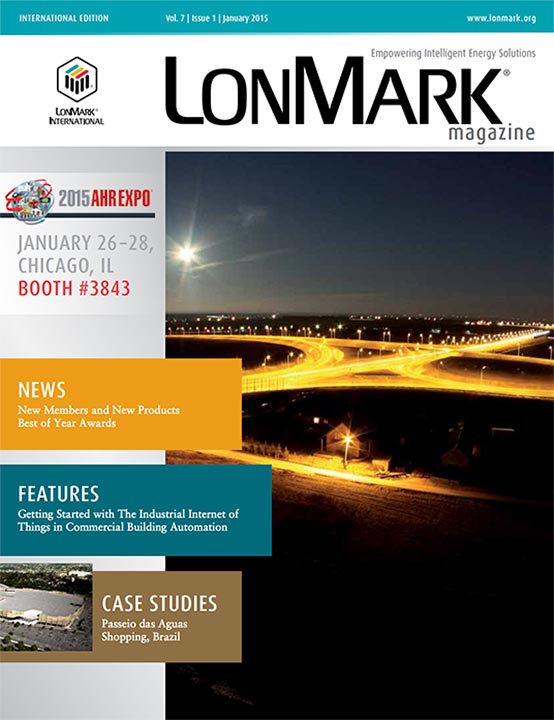
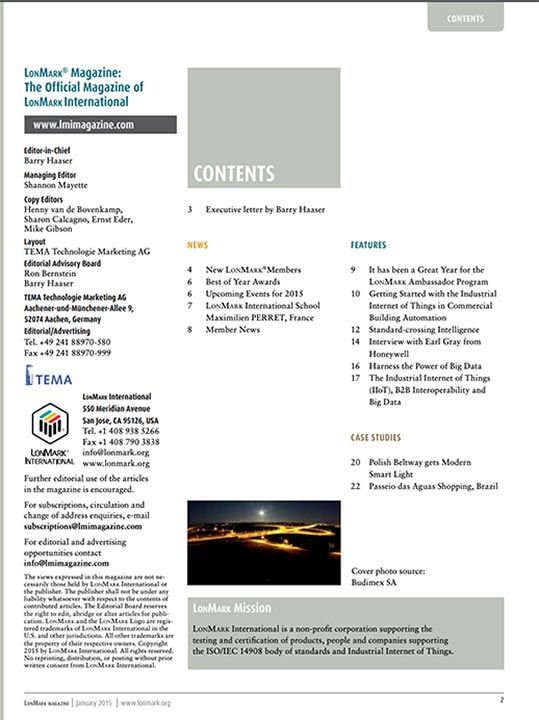
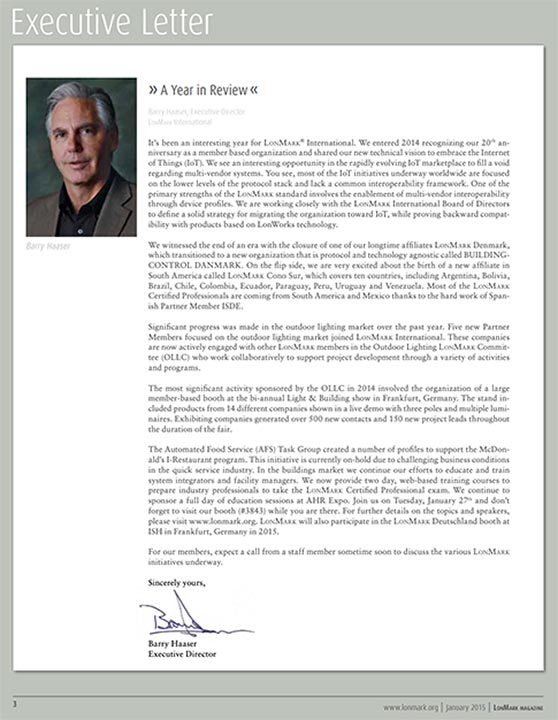
LonMark International Magazine
Vol.7 | Issue 1 | January 2015
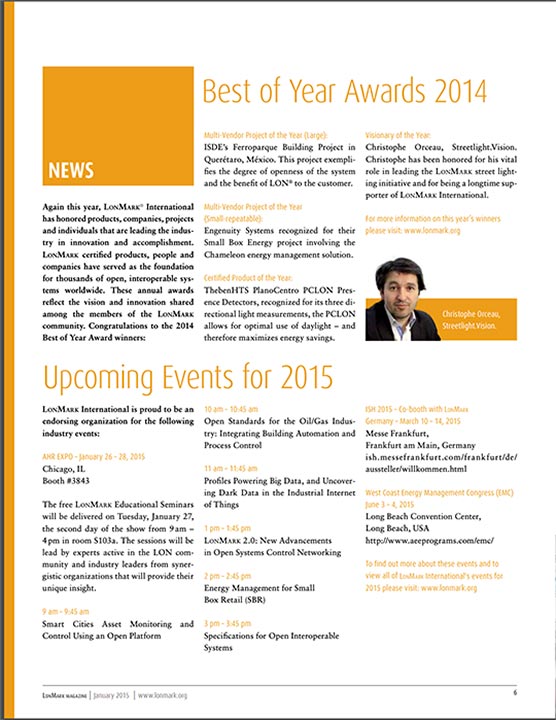
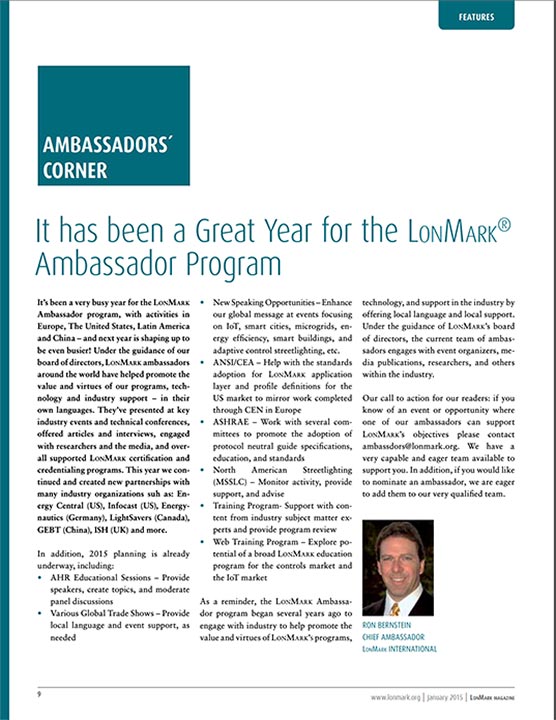
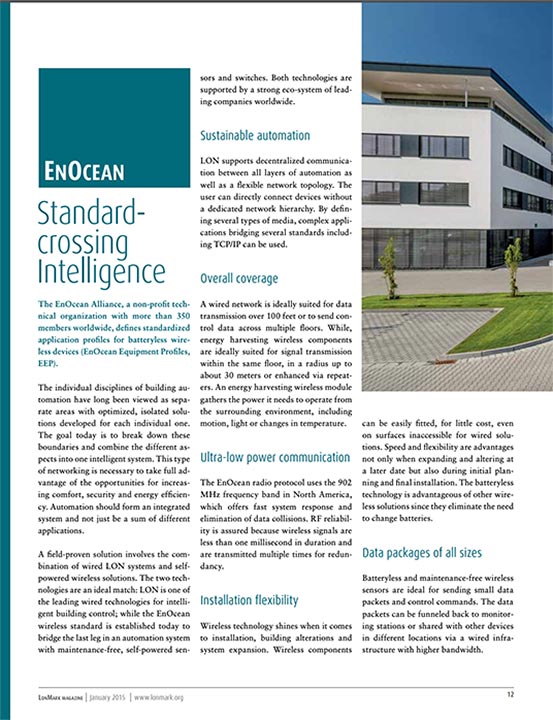
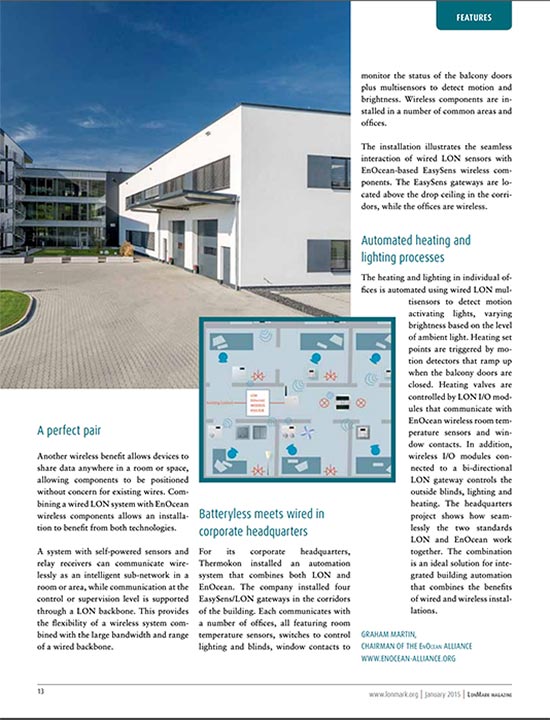
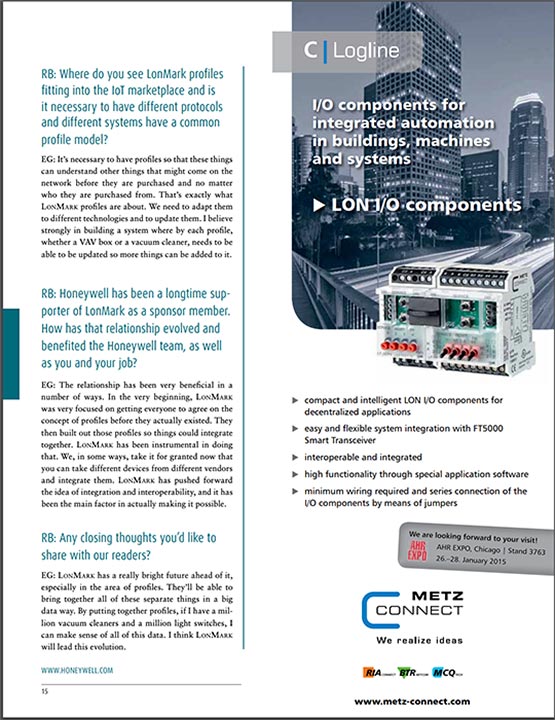
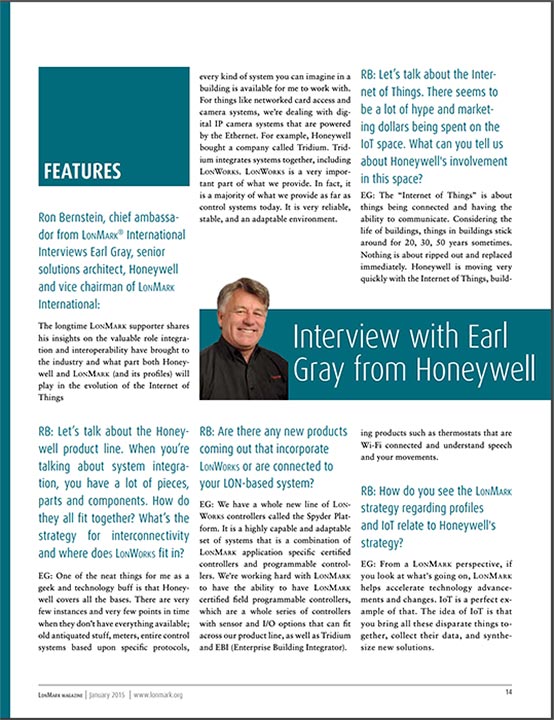
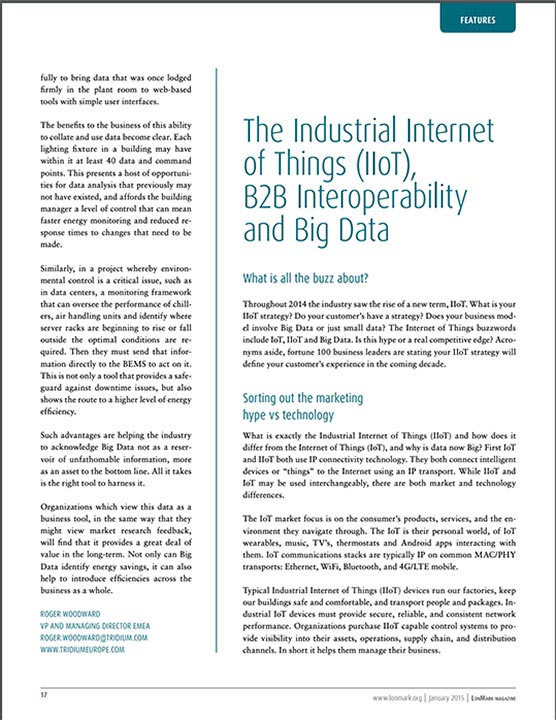
A few of the pages from the January 2915 issue of LMI Magazine.


~~~~~~~~~~~~~~~~~~~~~~~~~~~~~~~~~~~~~~~~~~~~~~
Editorial Focus
The LONMARK Magazine is the official magazine of LONMARK International published quarterly, in two editions: International and European. It is the only English-language trade magazine on open systems, written specifically for professionals interested in open, interoperable multi-vendor solutions. Each issue provides coverage on designing, specifying, installing and using open, interoperable solutions using the ANSI/EIA 709.1 protocol standard. technology and trends relevant to system integration of all sizes, along with in-depth application stories on building controls and automation, home, industry, telecommunications, street lighting, utilities, transportation, etc.
Target Audience
LONMARK Magazine readers are members and non-members of LONMARK International in a variety of industries such as building controls and automation, home control, industrial automation, telecommunications, street lighting, utilities, transportation, and more. They are specifiers and planners, architects, developers, systems and network integrators, researchers, investors and end-users. And they all share a common interest
Writing for the LonMark International Magazine
The LonMark Magazine is the official magazine of LonMark International published bi-annually. It is the only English-language trade magazine on open systems, written specifically for professionals interested in open, interoperable multi-vendor solutions. Each issue provides coverage on designing, specifying, installing and using open, interoperable solutions using the ISO/IEC 14908-1 related standards. technology and trends relevant to system integration of all sizes, along with in-depth application stories on building controls and automation, home, industry, telecommunications, streetlighting, utilities, transportation, etc.
LonMark International Magazine readers are members and non-members of LonMark International in a variety of industries such as building controls and automation, home control, industrial automation, telecommunications, streetlighting, utilities, transportation, and more. They are specifiers and planners, architects, developers, systems and network integrators, researchers, investors and end-users. And they all share a common interest in open, interoperable solutions throughout the United States, Europe and Asia.
Read this first before you get it down on paper ...
1. Submitting an article
All articles in the LonMark magazine consist of the following elements which simplify reading and help convey the information in a constructive manner.
-
Heading (significant, short and concise)
-
Lead text (introduces the article with essential information: 5 Ws and 1 H).
An interesting lead text will draw your audience into reading your article. -
Subheadings (subdivides the text with brief and concise titles, making the absorption of information smoother) are essential for all feature articles.
-
Keep your article to the set length mentioned above. Remember ... brevity is the soul of wit!
-
Make your conclusion as memorable as your lead. Instead of merely summarizing, try to surpass the limits of the article.
-
Do not include footnotes, but rather credits sources directly in the article.
2. Incorporating images and graphics
A picture is worth 1000 words. Illustrate your text with images to make it interesting and informative. All artwork must be either jpeg. or tif. images with a minimum resolution of 300dpi. We strongly encourage you to include captions with all images identifying the source.
Do not send articles with embedded images. The images must be submitted separately in individual files.
3. Technical Specifications
Unusual file formats, poor quality illustrations, etc. may lead to your article being bypassed for publication. We encourage you to follow the following rules:
Text:
Please send us your manuscript as Microsoft Word document. The manuscript should be left-justified and free from formatting. Do not embed images into the text! Images must be submitted in separate files.
Images:
Images must be saved as either jpeg or tif. File formats in at least 300dpi. Low resolution images will not be accepted!
4. Deadlines
The editorial deadlines must be absolutely respected. Article submissions received after the published deadline will not be printed in the upcoming issue.
Article Guidelines
The following guidelines are designed to help authors understand the article submission process for feature articles, application stories, and product news.
Feature Articles
Each Issue contains a special or prominent article that focuses on a particular topic of interest to readers. We seek articles that will appeal to a large, international audience. The article should be an original work ranging from 1,000 and 2,000 words. It should not promote a product, service or company. Please include a by-line and a brief biography giving the author's full name, title, and organization or company and its location.
Application Stories
LonMark Magazine readers enjoy reading articles describing the implementation of applications that stand-out. Involving multiple vendors or systems or that could be considered unique or unusual. Application stories should be between 600 and 1000 words and be a completed project less than 2-years-old. Preference will be given to installations containing LONMARK-certified, products. The body of the story should contain a background, challenge, solution and product specification details, along with a working title with an active verb. The article should reference the submitting organization or company and its location.
Product and Company News
We encourage LonMark members to submit news on new products or services. This information will reach thousands of potential customers worldwide. Please limit your news items to 200 and 250 words. Please make sure to include company contact information.
Evaluation and Acceptance
All manuscripts are evaluated based on originality of topic, organization, soundness of content, timeliness, and interest to our readers.
We may accept your article outright, accept it for Editorial Board rewrite, or accept it contingent on your revision.
Your writing style is your own, and we will make every attempt to preserve it. But if your article is substantially revised, we may send you the edited version for review.
~~~~~~~~~~~~~~~~~~~~~
Contact LonMark International
europe
Maguy de Mercurio
TEMA AG
Aachener-und-Münchener-Allee 9, 52074 Aachen
Germany
Phone: +49 241 88970 580
E-mail: mercurio@tema.de
United States
LonMark International
Shannon Mayette
550 Meridian Avenue
San Jose, CA 95126
United States
Phone: +1 602 882 4733
E-mail: shannon.mayette@lonmark.org

More Background On LMIMagazine.com
LMIMagazine.com served for many years as the digital home of LonMark International Magazine, the official publication of the global association devoted to advancing interoperable control networking based on the LONWORKS platform and related open standards. For professionals in building automation, industrial control, utilities, and smart infrastructure, the site became a familiar waypoint—a place where technical guidance, case studies, committee updates, and member achievements converged.
Although the address eventually ceded prominence to newer sections of the LonMark web ecosystem, its archived presence documents an important era in which trade publishing, standards advocacy, and early digital distribution overlapped. To understand LMIMagazine.com is to understand how a volunteer-driven standards body communicated with engineers, manufacturers, integrators, and policymakers during a period of rapid change in the automation world.
What follows is a detailed exploration of the magazine’s ownership, editorial mission, readership, influence, and continuing cultural relevance.
Organizational Ownership and Governance
The magazine was owned and operated by LonMark International, a not-for-profit membership organization founded in the 1990s to promote multivendor interoperability using LONWORKS technology. Unlike commercial publishing ventures, the periodical functioned as an extension of the association’s broader mission: education, certification, evangelism, and market development.
Editorial direction typically flowed from committees made up of member companies. These participants represented device manufacturers, software vendors, system integrators, consultants, and research institutions. As a result, the magazine often read like a cross-section of the ecosystem rather than the voice of a single corporate entity.
This governance model had advantages. It meant content came from practitioners deploying systems in real facilities—airports, campuses, factories, transport networks. But it also required careful balance. The editorial board regularly emphasized that feature articles should inform rather than promote, maintaining credibility within a technically literate readership.
Going Digital and Green
One of the defining milestones repeatedly highlighted in the magazine’s history was the mid-2000s transition from print to an electronic format. Years before “paperless publishing” became an industry cliché, the organization positioned the move as both environmentally responsible and technologically aligned with its audience.
By delivering issues directly to inboxes, LMIMagazine.com created a searchable, linkable archive. Readers accustomed to specification sheets and protocol documentation appreciated being able to retrieve material quickly. For integrators working across time zones, the digital format eliminated shipping delays and customs complications.
The shift also mirrored the association’s broader philosophy: networks should be open, accessible, and efficient. In many ways, the distribution method embodied the technical principles the group advocated.
Editorial Focus and Subject Matter
From its earliest issues through the 2010s, the magazine concentrated on several recurring pillars:
-
Standards development – updates on ISO/IEC progress, profiles, and certification programs.
-
Application stories – real deployments demonstrating interoperability.
-
Product innovation – introductions to newly certified devices and infrastructure tools.
-
Energy efficiency – particularly as sustainability mandates grew worldwide.
-
Training and workforce development – webinars, seminars, and career resources.
Because the readership included planners, architects, utilities, and transportation authorities, articles often bridged business and engineering. A campus energy retrofit, for example, might detail network topology while also discussing procurement models and lifecycle cost savings.
Audience and Reach
Unlike glossy consumer magazines, LMIMagazine.com targeted a highly specialized professional audience. Readers typically included:
-
specifying engineers
-
controls contractors
-
OEM product managers
-
facility owners
-
government agencies
-
researchers and investors
The magazine circulated among both members and non-members, extending the association’s influence beyond its dues-paying base. In regions where local chapters were still developing, the publication served as an introduction to the benefits of standardized, multivendor systems.
Because LONWORKS devices were installed in tens of millions of endpoints globally, even a niche readership translated into significant industry penetration.
Geographic Presence
LonMark International maintained administrative footprints in North America and Europe, with additional partnerships across Asia. Contact information frequently referenced offices in San Jose, California and Aachen, Germany, underscoring the organization’s transatlantic coordination.
This international orientation influenced the magazine’s tone. Articles needed to resonate with readers facing different regulatory frameworks, building codes, and utility markets. Consequently, case studies ranged from European district heating to American smart-grid pilots.
Role in Smart Grid Conversations
During the late 2000s, when governments began formalizing modernization strategies, the magazine became a vehicle for explaining how existing LONWORKS installations could integrate into emerging smart-grid architectures. Coverage often intersected with National Institute of Standards and Technology, which was tasked with identifying relevant standards.
By interpreting policy language for engineers, the publication helped members understand where opportunities might arise. It also encouraged community feedback during comment periods, reinforcing the collaborative ethos of standards development.
Committees, Collaboration, and Community
Regular columns updated readers on marketing initiatives, advisory groups, and technical working parties. For instance, the formation of lighting committees in the late 2000s reflected growing awareness that intelligent controls could produce dramatic energy savings both indoors and outdoors.
These reports may seem procedural, yet they documented how volunteers shaped industry direction. LMIMagazine.com thereby acted as institutional memory, capturing incremental progress that might otherwise have been lost.
Advertising and Commercial Participation
While editorial independence was stressed, advertising played a practical role. Vendors could purchase placements to introduce new routers, sensors, or software platforms. Rate cards and insertion forms were publicly available, reflecting transparency.
Because readers were precisely the professionals who influenced procurement, such ads held significant value. For smaller firms, appearing alongside multinational brands conferred legitimacy.
Submission Guidelines and Professional Standards
A distinctive feature of the site was its detailed guidance for contributors. Manuscripts were to be concise, structured with headings and subheadings, and delivered without excessive formatting. Images required high resolution and separate files.
These requirements reveal how seriously the association treated communication. Articles were not casual blog posts; they were expected to withstand scrutiny from engineers who might base specifications on the information provided.
Publication Frequency and Evolution
Over time, references alternated between quarterly and biannual schedules. This fluctuation likely reflected resource availability and shifts in volunteer capacity. Nevertheless, the commitment to continuity remained strong. Even during periods of industry turbulence, issues continued to appear.
By the mid-2010s, digital transformation across the media landscape accelerated. Social platforms, webinars, and newsletters began sharing the spotlight. Yet the magazine retained symbolic importance as the official voice of the organization.
Press Coverage and Industry Recognition
Announcements about premiere issues emphasized participation in major expos and seminars. Tying releases to global events ensured immediate visibility among professionals already gathered for networking and procurement.
Being cited in trade environments such as HVAC and building-automation exhibitions amplified the magazine’s stature. For many attendees, picking up an issue—or later downloading it—was part of engaging with the broader standards movement.
Educational Mission
Beyond news, LMIMagazine.com reinforced LonMark’s belief that adoption depended on understanding. Articles demystified protocol stacks, certification pathways, and integration challenges. They translated abstract interoperability promises into tangible workflows.
This pedagogical approach proved particularly useful for newcomers evaluating whether to migrate from proprietary systems. Seeing documented successes from peers reduced perceived risk.
Cultural and Social Significance
Within the specialized realm of open controls, the magazine functioned as more than media; it was glue. It connected engineers in different continents, highlighted volunteer achievements, and celebrated milestones such as newly ratified standards.
In industries where practitioners often work behind the scenes, such recognition fostered pride and continuity. Many veterans still reference past issues when recounting how particular technologies gained acceptance.
The Archive as Historical Record
Today, archived versions of LMIMagazine.com provide historians and technologists with snapshots of evolving priorities: early enthusiasm for web integration, later focus on cybersecurity, persistent concern for energy performance.
Because the material spans over a decade, researchers can trace how terminology matured and how pilot projects scaled into mainstream deployments.
Relationship to the Broader LonMark Web Presence
Eventually, content migrated toward the association’s primary domain, consolidating resources such as training portals, event calendars, and news updates. Nevertheless, LMIMagazine.com remains recognizable as a bridge between print heritage and modern digital outreach.
Why It Still Matters
For professionals navigating today’s IoT-driven environment, revisiting the magazine underscores that many interoperability debates are not new. Questions about vendor neutrality, certification rigor, and lifecycle maintenance were being addressed years ago.
The publication therefore offers continuity, reminding readers that current innovations rest on decades of collaborative groundwork.
LMIMagazine.com chronicled the ambitions of LonMark International as it sought to transform fragmented control markets into cooperative ecosystems. Through committee reports, application narratives, and standards updates, the magazine nurtured a shared language among diverse stakeholders.
Though distribution methods and branding have evolved, the legacy endures. Engineers who leaf through archived pages encounter not only technical documentation but evidence of a community determined to make openness practical. That determination continues to shape intelligent environments worldwide.